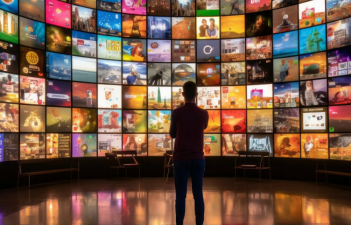
The emergence and widespread adoption of new media have undoubtedly brought numerous changes to our lives. It has altered how we access information, our social habits, and even our way of thinking. "Under the allure of entertainment, we may gradually lose our freedom, and may even lead ourselves to self-destruction because of what we love"—Neil Postman's 1985 prediction, which sends chills down our spines today. This is not a book against entertainment, but rather a work aimed at warning the world how media profoundly influences our way of thinking. Neil Postman's core argument is that media is not merely a carrier of information; it is a profound metaphor, subtly shaping our culture, thought patterns, and even social structures.
The Transformation of Information Access
In the era of traditional media, people primarily relied on newspapers, television, and radio to obtain information. The emergence of new media, especially the widespread adoption of mobile internet, allows us to access various types of information anytime, anywhere. News, videos, music, books, and other forms of content can be easily accessed through mobile phones or computers.
The Shift in Social Interactions
The rise of social media has expanded people's social circles beyond just friends and family, extending them globally. People can make new friends, share their lives, and exchange ideas through social media platforms. Social media has also become an important way for people to express and showcase themselves.
Changes in Mindset
The emergence of new media has also changed our way of thinking. For example, the popularity of short videos has led people to quickly absorb information rather than reading in depth. At the same time, the comment function of social media makes it easier for us to participate in discussions, thereby promoting the improvement of our thinking and expression abilities.
Stages of Media Evolution
With the continuous development of media technology, we can easily see that media evolution has undergone a shift from rationality to entertainment. In the early days, media mainly served the function of transmitting information and facilitating rational thinking, such as print media like newspapers and magazines, which provided readers with space for in-depth reflection. However, with the rise of new media such as television and the internet, the function of media has gradually changed. New media tend to simplify information and emphasize visual and entertainment effects, which has gradually reduced the proportion of deep content such as philosophical thinking in the media. Therefore, we can divide the evolution of media into three stages: the rational stage, the emotional stage, and the entertainment stage.
▣ The Printing Press Era (The Age of Reason) The Age of Reason emphasized logic and depth; the public possessed the ability to process complex information.
Characteristics:
- Coherent, serious, and logically clear discourse;
- The public possessed the ability to process complex, long sentences and abstract concepts;
- Long attention spans enabled in-depth reading and reflection.
Case Study:
The Founding Fathers of the United States were all excellent readers and adept at rational debate.
▣ The Television Era (The Age of Entertainment) Emphasis was placed on entertainment and visual effects, reducing the presentation of philosophical thought.
Characteristics:
- Content was entirely entertainment-oriented; news, politics, and religion all became performance stages;
- Attention was fragmented, making deep focus and reflection difficult.
Classic Cases:
News channels used opening themes to package major disaster events, downplaying their seriousness;
Missionaries became television stars, and self-help philosophies flourished.
▣ The Internet Age (The Age of Revelry and Immersion) Provided immersive entertainment, making it difficult to distinguish between reality and fiction.
Characteristics:
- Entertainment experiences are upgraded to immersive experiences, with algorithmic recommendations replacing active thinking;
- The lines between reality and fiction become blurred and difficult to distinguish;
Political elections evolve into competition among internet celebrities, and social issues become a stage for taking sides.